
Read a book and change the world
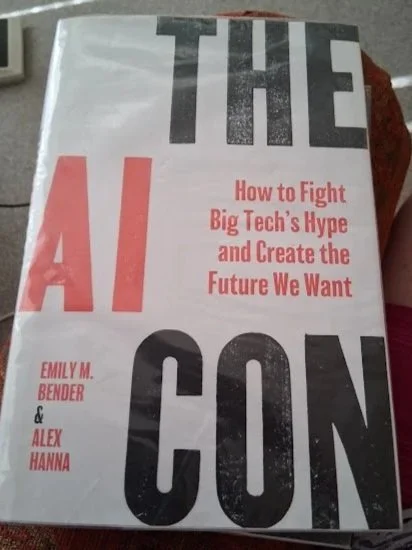
It is rare I read a non-fiction book. I have a few on my bookshelf that sometimes star at me accusingly and I dream one day I will be inspired to pluck one from its resting place, open it and read. In the meantime, maybe just staring at the titles will help me absorb the ideas within?
It is even more outlandish that I read a non-fiction book from cover to cover. But I was in the library last week and something caught my eye. The title was The AI Con.
Grabbing it from the shelf I started to read, there was a cool breeze through the window and it was very hot outside, but this was about more than finding respite from yet another heatwave.
AI is a HOT topic and I have firmly aligned myself on the side of the AI haters.
Yes, hate is a strong word and as with most people vehemently against it I sometimes get laughed at because it is in EVERYTHING, so I am using it regardless of my stance and it is so much fun/makes life simpler/it’s called progress.
There is much to unpack but before I address some serious issues let me set out some of my own credentials.
Although I have never worked in a library, I have a degree in Library and Information Studies. Computing was one of our options and we were early adopters of computerised information systems, learning how to search databases for information. It was a whole new world in the late 80s/ early 90s.
We also had a media option to our course, learning skills to synthesise information and repackage it into a form that meets the users needs. We learnt and developed skills in photography, radio and video production, multimedia presentations (which back then was a complicated slide show not a Powerpoint) and making posters.
My youngest son has a masters degree in computer science – a first no less (note I never told you my class – think of a ballerina!). He has studied the rise of this panacea we call AI and is none too impressed with the way things are heading. We have very deep discussions and now I have read this book I feel I have a greater understanding too.
So, let’s pull apart the curtain and see what exactly Artificial Intelligence is, or maybe what it is NOT.
We have grown up with this idea that sentient robots like C3PO will save the day. At least that is the best-case scenario. Let’s skip the robots in Terminator, they are just a bit too scary. If we could pick and choose a robot maybe we would choose one like Linda, the latest android on the block as seen in the BBC series Ann Droid, excellently written by Diane Morgan, who plays the role to perfection.
This is what we imagine when we think of Artificial Intelligence, robots that do all the naff stuff we don’t want to do so we can live the life of luxury. A robot to clean the loo perhaps?
At the other end of the scale, we imagine that AI will solve our serious world problems, give us solutions to the climate crisis and find a cure for cancer.
Unfortunately, AI is NONE of those things because Artificial Intelligence is a made-up marketing term which is actually pretty meaningless. It’s that sparkly icon of stars that supposedly adds some glitter to your life. Believe me I know all about glitter and this isn’t it!
My son says it’s just a buzz word and it gets everyone excited at the possibility of a shiny future. The people that get most excited are the tech bros with dollar signs flashing in their beady eyes, because nothing gets investors more over stimulated than the idea of exploiting a new idea to make money.
There are systems for machine learning, translation, systems for making decisions based on a set of programmed parameters, and then there are LLMs (Large Language Models) that can generate text and images. All of these have a different function and depending on how they have been designed and programmed they have their uses.
Lumping all of this technology under the umbrella term of Artificial Intelligence appeals to the lay person with only a rudimentary understanding of the dark arts of computing. Sticking an AI sicker on something gives it some kind of kudos. The same as the term SMART – smart phones, smart cars, smart fridges.
In looking for the next big thing it is easy to fall for the hype, because no one wants to be left behind or heaven forbid be called a LUDDITE!
The book looks into the history of the Luddite movement, which I will admit I know all too little about – perhaps the next book I read will be a history book looking back rather than forwards, because everything is always repeated.
AI is just the latest bubble and I keep reading online it is about to burst, but when it goes pop who wins and who inevitably loses?
Shall we call it Artificial Ignorance rather than intelligence, because a computer system is still only as good and reliable as the data put in by a human!
And there are a lot of humans behind the scenes, outsourced in other countries where labour is cheap and people are expendable. Someone has to look at hideous images all day categorising them, deciding what is acceptable. Now this is something I had no idea about. It may only be a part of it but in the rush to get the latest product on the shelves people are being exploited in exactly the same way as we (those of us living comfortable western lives) have exploited the majority world for a long time – think tea, coffee, chocolate – all those lovely things we kind of take for granted. Seems like AI production works in the same way – devaluing humans that just happen to live in another part of the world, far enough away that we can forget about them.
LLMs and what we term generative AI devalues ALL human creativity. Suddenly everyone can be a writer or an artist. Type in a prompt and out pops … AI slop!
Posters that all look the same, filled with far too many words and images that overwhelm us, faces with uncanny cartoon eyes, people with three arms and six fingers! There is little thought put into them, no joy in designing them, all pleasure is sucked away as you feed even more information into the machine.
As for writing the next best seller - forget it. LLMs are totally derivative and can only regurgitate the material it has been fed. Words that have been stolen from real writers, some of my friends included. There is no originality.
“Ah but if you ask Chat GPT a question it can be really helpful.”
DON’T even go there, do you know people have committed suicide after conversations with chatbots. Human life is cheap.
In fact, human life can be a bit of an inconvenience, we are mostly made of water, but we need to stop consuming so much of is as the new AI data centres require vast amounts to cool them down. Information is power and money.
Am I going off into a tangent, am I raging and ranting? Well yes maybe I am because there is an unjustness to this, an unfairness I want to expose.
Pandora’s box has been opened and we have been promised so much by the tech trillionaires but they have delivered so little.
Yes, there are computing and automation systems that can help us in the right hands if they are fed the right information to start with. Sadly, we now have to wade past so much dross to get to the nuggets of helpful information, like swimming in a sea full of sewage to find the hidden treasure. Garbage in - garbage out is a term which has been around for a long time and will always be true.
LLMs do not have the capacity to learn as humans do. Maybe other systems can but it’s the generative AI I hate the most for churning out plausible answers that suit our current desires not definitive answers than can really help us.
Now it is just up to you to decide if I have churned out something useful after devouring a book. I have simplified many of the points, maybe got a few wrong along the way but then I am only human! I have used my own experiences and wit in writing this and you are entitled to disagree and make comments below.
Will these words make you search out and read the book? Will you look into things further or just go about your day and turn yourself into a dancing cat, or whatever the latest craze might be.
I hope I have at least given you some food for thought and you won’t be automatically wowed by the sparkly star icon in the corner of the screen. It may be able to help you write that all important email, but you know what, you can do that all by yourself – you really are more intelligent that you think.
The AI Con: How to Fight Big Tech's Hype and Create the Future We Want is a 2025 non-fiction book by linguist Emily M. Bender and sociologist Alex Hanna. It argues that much of what is labelled "artificial intelligence" is a misleading term that obscures ordinary automation while concentrating power in a small number of technology firms. Wikipedia