
Information Overload!
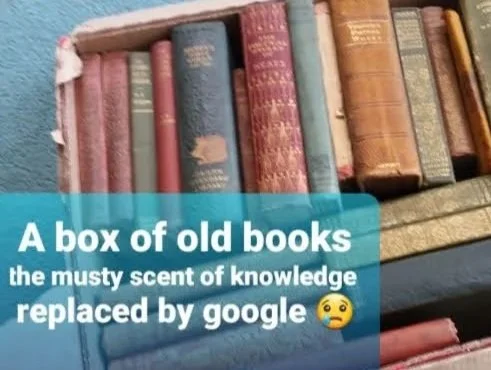
Some old text books full of information superseded by the internet.
Maybe I am odd but I clearly remember my very first internet search. It was the late 80’s and I was looking for information about SCART sockets. Those big chunky adaptors often plugged into the back of old TVs to connect your VHS player. Probably the grandparents of the more slimline HDMI cables we are familiar with today.
You might think this was an odd topic to search for but I was a student at the time, doing a degree in Library and Information Studies. Completing an online search was a piece of homework, we worked in pairs and were each given something to look up in the computer suite. We didn’t have individual tablets or phones back then. The internet and search engines and all the stuff we now take for granted was completely new to us. The excitement was palpable and our degree was quite cutting edge for its time.
Scrolling on social media last week I was reminded of this challenge when I found a reel about college students in the US given the task of finding information the old fashion way, using a library full of BOOKS, even finding out what a glossary was. These students got really excited about what they could discover in the printed word.
Curiosity is such a wonderful thing, it needs satisfying with facts and knowledge. Just like when you are hungry you need a sandwich, or a bag of crisps, perhaps a healthy apple would be a better choice than a chocolate bar?
Just like the food we eat to sustain us comes in all kinds of varieties so does information. Something like candyfloss is just empty calories, not really giving us much nutritional value. In the same way scrolling on social media can gratify us momentarily or lead us down a rabbit hole that isn’t really that fulfilling in the long run. Half the time you forget what you went looking for in the first place. But you have watched a cat tap-dancing, and signed up for a year’s supply of collagen so maybe it wasn’t a waste of time after all.
Did you know 43% of Americans get their news from Facebook? At least that is the final statistic you are left with at the end of the latest Aaron Sorkin film The Social Reckoning, which I went to see yesterday.
I think I gasped at that, not least because the film clearly documented how algorithms are manipulated and facts are not verified. Some facts used to be checked but now it is a free for all of “free speech” where misinformation can and does spread like wild fire unrestrained.
It’s been an interesting week for the flow of information after Ukraine targeted a Russian data centre and suddenly many online bots have disappeared. The air seems cleaner and more breathable. I wonder how long it will last?
Then Andy Burnham, current British PM*, actually admitted there was Russian interference in the Brexit vote. Most of us knew it, it wasn’t really a conspiracy theory. But there are people who were swayed by misleading statistics and information who genuinely believed they were voting for something good. We can’t blame them all for being idiots!
So how do we figure out the truth?
I know I told my brother once I get most of my new from social media and he was horrified and to this day still believes I am ill-informed. To clarify I rarely watch the news at ten on either side**, I do occasionally watch Channel 4 News and I am discerning about what news reports I listen to online. I may not know everything that is going on – I don’t think anyone does – but I like to think the skills I learned on my degree have stood me in good stead for weeding out most of the lies and giving me as good a grasp of the truth as anyone else.
Then I go and watch films like The Social Reckoning. Again, I have no doubt there is much artistic licence in the plot and some of the scenes didn’t quite play out in real life as it does on screen. But it’s a starting point for a debate about some serious issues.
Frances Haugen, the Facebook whistleblower, joined the company with a determination to create a less toxic platform after someone she knew became radicalised. Once upon a time Facebook was a wonderful place of connection but rage bait gets more clicks and more clicks gets more advertising revenue, keeping the shareholders happy.
Our dependence on social media still grows because we are invested, our friends are there, local groups and business contacts, leaving it all behind is practically impossible.
The downward spiral of doom continues and there is a name for it - ENSHITTIFICATION, a term coined by writer and blogger Cory Doctorow. I’ve just finished reading his book of the same name. It’s another fascinating read, just like The AI Con book I read and blogged about earlier in the year. It’s all part of my personal mission to get more informed and find ways to combat the torrent of misinformation.
I would wholeheartedly recommend Cory Doctorow’s book as a way to understand why tech has got worse over time and not better as you might expect. He also writes about where there is some hope for the future. There are bits I glossed over because it was about American legislature that I didn’t understand, but the general gist is good and his writing style can be quite cutting, I laughed out loud a few times.
I would also recommend The Social Reckoning, watching a film is maybe easier to digest than reading a book, but both give you an insight into how things can be manipulated by people who don’t have our best interests at heart.
Being more aware of what’s happening behind the scenes can hopefully expose more truth in these overwhelming times of information overload.
*Our PMs still change far too frequently in my opinion and this blog might be read many years from now when Mr Burham has outlasted his usefulness.
** either side meaning BBC 1 or ITV – I’m THAT old! I rarely watching any ‘live’ TV except Wimbledon!